
The Turf Hut (no. 15)
The unique Sámi dwelling
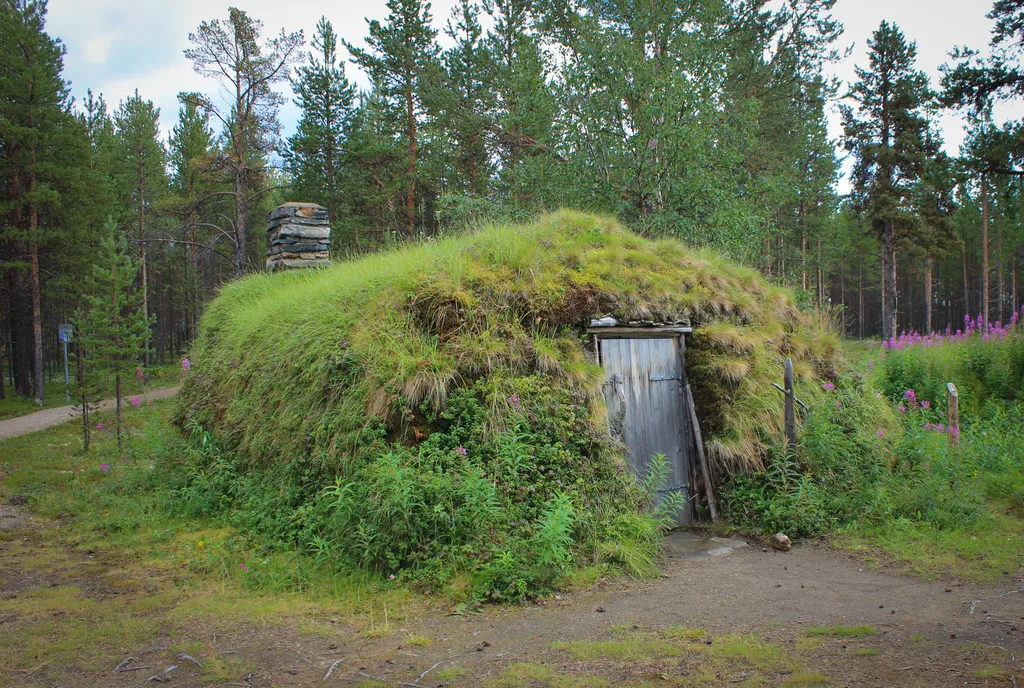
In the harsh conditions of the Arctic region the Sámi way of life required skills and technical know-how for making various types of dwellings. An important milestone in the development of Sámi building techniques was making use of the arched poles of the lávvu, the movable fabric-covered Sámi conical tent, as a framework for permanent dwellings covered with turf, the lavdnjegoahti or turf hut.
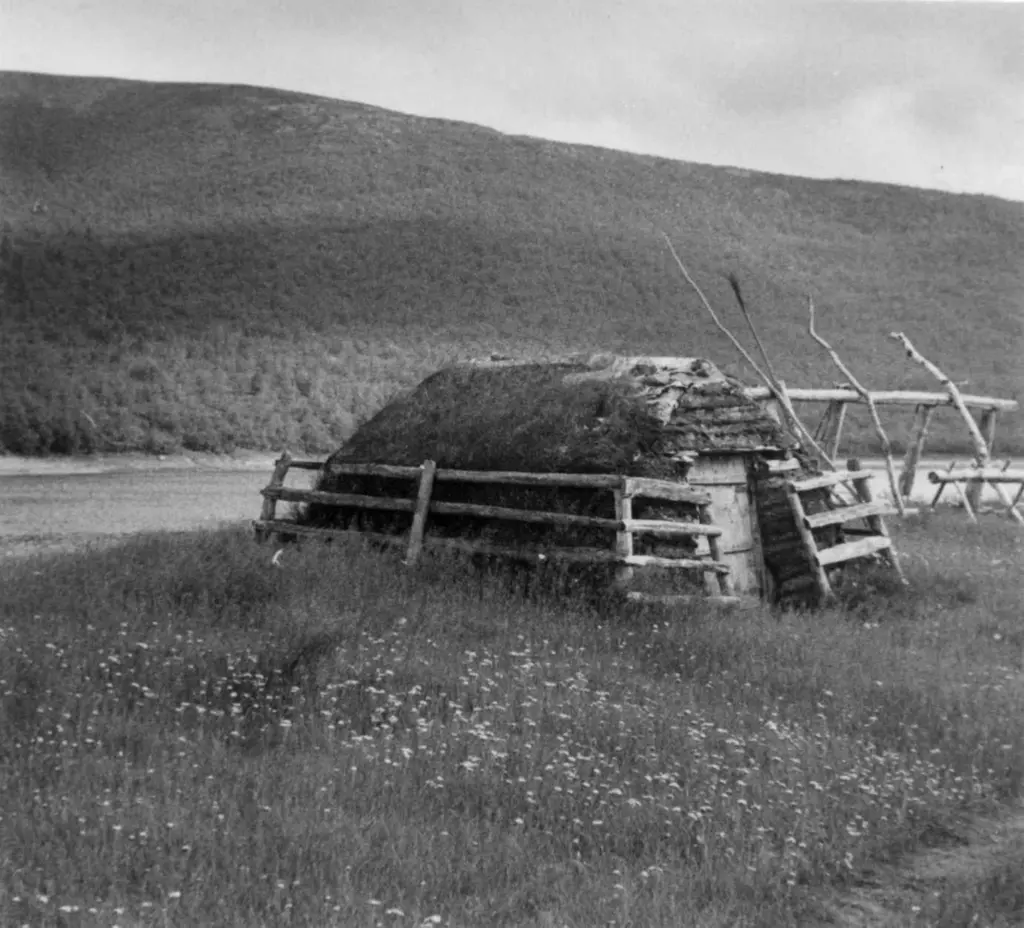
The turf hut is made of wood resting on a structure covered with birch bark and peat to provide a durable construction. The frame is made from curved birch. Curved poles are then laid against the frame, pegged and covered with overlapping sheets of birch bark, which are kept in place by layers of turf stacked against the sloping walls. Curved birches are found growing on hillsides. Such trees bend near the root in order to grow upright and are perfect for the curved poles of the lavdnjegoahti. The whole structure rests on stones, the weight of the turf and its parabolic profile providing stability.
At the front and back of the turf hut are stone vents. The lower layers of birch bark are held in place by a thicker layer of turf. All the materials, wood, bark, turf and stone, are found locally. With regular maintenance, a turf hut will stand for many decades.
In some areas, Sámis lived in turf huts until the Second World War. After the war turf huts were mainly used for keeping domestic animals.
The larger turf hut
Sparrolavdnjegoahti is a larger permanent dwelling, with a construction like that of the bealljegoahti, the curved pole tent or turf hut. Sparru means curved construction, lavdnji means turf, and goahti a hut.
This large turf hut shows the traditional Sámi method of construction, typical for northern coastal areas. The sparrolavdnjegoahti is more spacious than a bealljegoahti, the curved pole turf hut, and warmer than a lávvu, the movable tent. In the larger turf hut there is space for several rooms.
The fireplace is traditionally in the middle of the curved pole turf hut, but in the larger turf huts the hearth was placed near the door or in a corner. In coastal areas Sparrolavdnjegoahti were used to house both people and livestock: a sheepfold could be built inside it. It was resourceful because having the sheep inside kept the whole dwelling warm.
More recent turf huts had windows made of glass. In the earlier times dried cod stomach was used.
Sparrolavdnjegoahti in the Open-air Museum
This larger turf hut was built in 1980s as part of the film project Sami Dilit , the situation of Sámis. The film was produced by the former Norske kunst og kulturhistoriske museer, the Norwegian Association of Museums of Arts and Cultural History, now renamed Norges Museumsforbund, the Norwegian Museum Association. The film project was funded by the Arts Council of Norway. The craftsmen were Jon Ole Andersen and Nils Turi.
Watch the film about building a turf hut
The film was made in the Open-air Museum in 1980. Duration: 33 minutes.
Film title: Goahte-ceggen: Kárášjohka 1980 – Building a turf hut, Karasjok 1980. Producer: Norske kunst og kulturhistoriske museer, 1981. Narrator: Johs Kalvemo. Filmmakers: Olav Kyrre Grepp, Arild Nybakken, Håkon Danielsen, Anne Berit Ø. Borchgrevink, Arthur Sand, Bjørn Harald Hansen.
Film: Goahte-ceggen
In 1991 Per Mienna and Thorolf Bjørnback repaired the roof of the turf hut under the leadership of craftsman Greita-Ánte Osvald (Osvald Guttorm).